

Membrane filtration microscopy
The single most important analysis — without it, any oil analysis is incomplete.
Benefit 1: More accurate assessment of oil condition
Signs of oil ageing are almost always detected earlier through membrane filtration (on the membrane surface) than through oxidation values from infrared (IR) spectroscopy or an increase in Total Acid Number (TAN). The oil’s darkened colour is typically not a reliable indicator of ageing.
The images below illustrate progressive oil degradation (polymerization, varnish formation) that are not visible with other analysis methods in time.

Membrane filtration correlates well with the results of the MPC test.
Benefit 2: More accurate detection of component wear
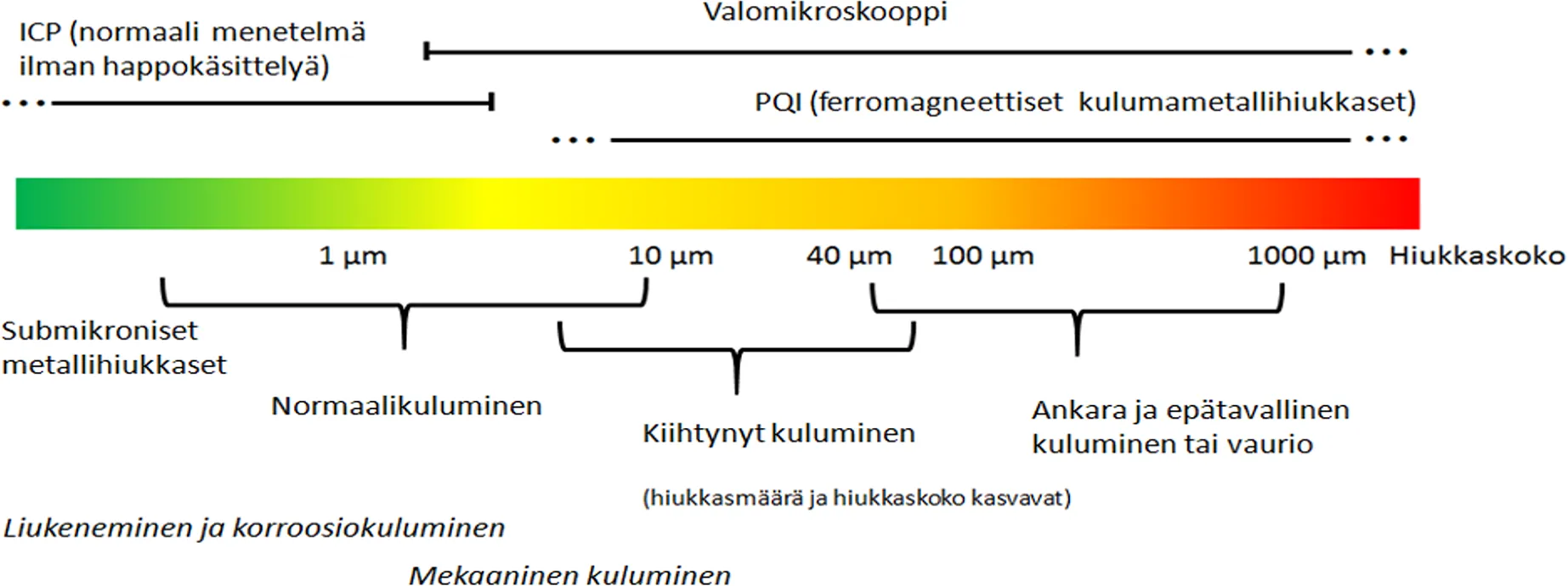
Wear metal analysis via ICP elemental spectroscopy is one of the most important oil tests. However, it doesn’t give a complete picture of the wear particles in the oil. The limitation lies in the fact that the most critical particle sizes — those that indicate accelerated or severe wear — do not show up in elemental analysis results. The instruments used in laboratories (based on the same measurement principle) cannot detect metal particles larger than 3–5 µm.
As a result, a transition from normal to accelerated or severe wear often goes unnoticed unless the oil is filtered through a membrane and the particles larger than 5 µm are examined microscopically in terms of quantity, size, and shape.
ICP analysis is very suitable for engine oils, where most wear particles are mostly small due to abrasive and rubbing wear. In contrast, in industrial oil applications, skipping membrane filtration and microscopy can be critical.
The diagram below illustrates particle sizes generated by different wear mechanisms and the suitability of various measurement methods for detecting wear metals.
Benefit 3: More accurate particle cleanliness assessment
The true number of particles in oil and its cleanliness class can only be reliably confirmed by microscopic examination of the membrane filter. Relying solely on particle counter results is risky, as they are prone to multiple sources of error.
The most common source of error comes from oil additives, such as antifoaming agents or viscosity index improver polymers, which may not be fully dissolved in the oil. Other error sources include moisture, air bubbles, protective additives, and greases. These can all distort the particle count. Additional issues include oil that’s too dark for the counter’s optics, high viscosity, or high particle concentrations — which can overwhelm the counter’s resolution and cause so-called coincidence errors. Oil can also contain non-particulate contaminants like sludge or gels that skew the results.
Warning from Finland’s best-known particle counter distributor:
“Always first suspect the particle counter result.”
Particle counters often raise more questions than they answer:
- Does the particle counter give a reliable result for this specific oil type?
- If the result is distorted, what’s causing it?
- Are the particles counted truly solid — or could they actually be semi-solid or soft contaminants that the device has mistakenly identified as “particles”?
- If the cleanliness class is lower than acceptable, where are the particles coming from? What is the main contaminant, and what other particle types are present (e.g., wear metals, rust, dust, polymers, fibers, grease residue, additives, paint, microbes, varnish, or depleted additives)?
- What is the maximum size of the wear metal particles? Is the wear normal, accelerated, severe, or already causing damage?
- What type of filter would remove, for example, 90% of the contamination mass?
- What maintenance actions are needed — or is any action required at all?
- Could the particle counter be missing fine, submicron (<1 µm) resinous varnish or sludge that may be a major harmful contaminant?
Always demand membrane filtration microscopy as part of your oil analysis!
At Fluidlab, this analysis is already included in every package.
Keep your machines running without disruptions
We’ll create the perfect analysis package, customized to your exact needs.